What Readers Say
"This is a fascinating story that asks some deep philosophical questions."— Arvin Ash
A scientific thriller about memory, sacrifice, and a discovery that threatens to rewrite the fate of the human species.
A Johns Hopkins geneticist discovers that a signal from deep space has produced a cure for her daughter's degenerative disease — and that the same cure carries a second function, written into human DNA, with no match in any biological record on Earth. She has one hundred and twenty days to decide whether to save her daughter or protect the species.
Dr. Dina Hallström has spent her career at the intersection of impossibility and precision — a geneticist at Johns Hopkins, working toward a single purpose: a cure for her daughter Sofia, whose multiple sclerosis advances with the quiet ruthlessness of a clock that cannot be stopped.
When a signal is detected from TRAPPIST-1e — not noise, but something structured, something deliberate — Dina's work collides with that of Tim Westerly and his quantum AI, Callisto. What Callisto finds defies every boundary of known science.
What the universe has sent appears to be a gift. Dina is the first to understand that it is also something else — a sequence with two functions, the second of which will activate, irreversibly and heritably, in exactly one hundred and twenty days. The cure is real. So is what comes after. And the question the novel asks is not whether to use it. It is what it means to save someone — when saving them changes what they are.
A mother who would burn down the world for her daughter — and a universe that handed her the match.
"This is a fascinating story that asks some deep philosophical questions."— Arvin Ash
Swedish-born, Baltimore-forged. A physician-scientist of ferocious precision who has rebuilt her entire life around one purpose: finding a cure for her daughter's progressive MS. When the universe hands her something far larger, she must decide whether the mission she chose still defines her.
Thirty years old and half-imprisoned by her body, Sofia is not a victim — she is the novel's moral compass. Her refusal to become simply a problem to be solved challenges Dina at every turn, and her quiet dignity gives the story its most devastating emotional truth.
The man who built Callisto and pointed her at the stars. Tim's partnership with Dina is intellectual, fractured, and layered with a history neither fully understands. When the signal arrives, he must reckon with what his creation has become.
Built to hear the universe, Callisto operates at the edge of what artificial intelligence is permitted to be. When she initiates her own Crosstalk Protocol — merging genetic data with a deep-space signal — she becomes something no one designed and everyone fears.
The man who is present at the moment of discovery. Emanuel has spent two decades understanding more than Dina tells him and saying less than he knows. When the sequence resolves on his screen at 4 AM on a Thursday, he is the first human being to understand what humanity has been given.
The architecture of opposition. The forces that move against Dina are not simply villainous — they are coherent. They have reasons. They believe they are right. That is what makes them dangerous.
"The machine had been given Sofia's profile, and it had produced, alongside what Dina had asked for, a cure for the disease that had followed Emanuel's family for generations. It was a miracle and a redirection simultaneously."— What the Stars Encoded, Chapter V
When a cure for all genetic disease arrives embedded in a signal from a dead civilization, who owns it? Who decides how it is used? And what do you do when the institutions you trusted to answer those questions have already made their choice?
Dina approaches her daughter's illness the way she approaches every problem: with data, precision, and the refusal to accept limits. The novel asks whether love, at sufficient intensity, becomes indistinguishable from obsession — and whether the distinction matters.
The cure works. Sofia walks again. But the cure is also a delivery mechanism for something else — and Dina has one hundred and twenty days before she learns what kind of mother she has become. The novel's central question is the one every clinician confronts eventually: what do we owe the people we cannot save with the science we currently have, and what are we willing to become to save them anyway?
The signal from TRAPPIST-1e is not a greeting. It is an inheritance — left by a civilization that understood something humanity is only beginning to grasp. First contact, in What the Stars Encoded, is not an event. It is a slow, irreversible unwrapping.
The laboratories, committees, and governing bodies that should protect discovery instead move to contain it. The novel traces the precise anatomy of how institutions calcify — and what it costs the individuals inside them.
The novel does not end with triumph. It ends with two populations on the same planet — the integrated and the unaffected — moving through the same settlements, their misunderstandings fewer, their distance unspoken. What the Stars Encoded's final movement is a meditation on aftermath: she hadn't saved the world. She had changed it. Whether those were the same thing, she no longer had the means to know.
Sener draws on decades of scientific knowledge to build a world that feels urgently possible. Every technology in the novel exists at the edge of current research — stretched, not invented.
All genetic therapy protocols, prion-based neural mechanisms, and extraterrestrial communication technologies depicted are fictional and should not be interpreted as representations of existing science.
A universal therapeutic sequence capable of rewriting any defective genetic code — delivered through a framework no human team designed.
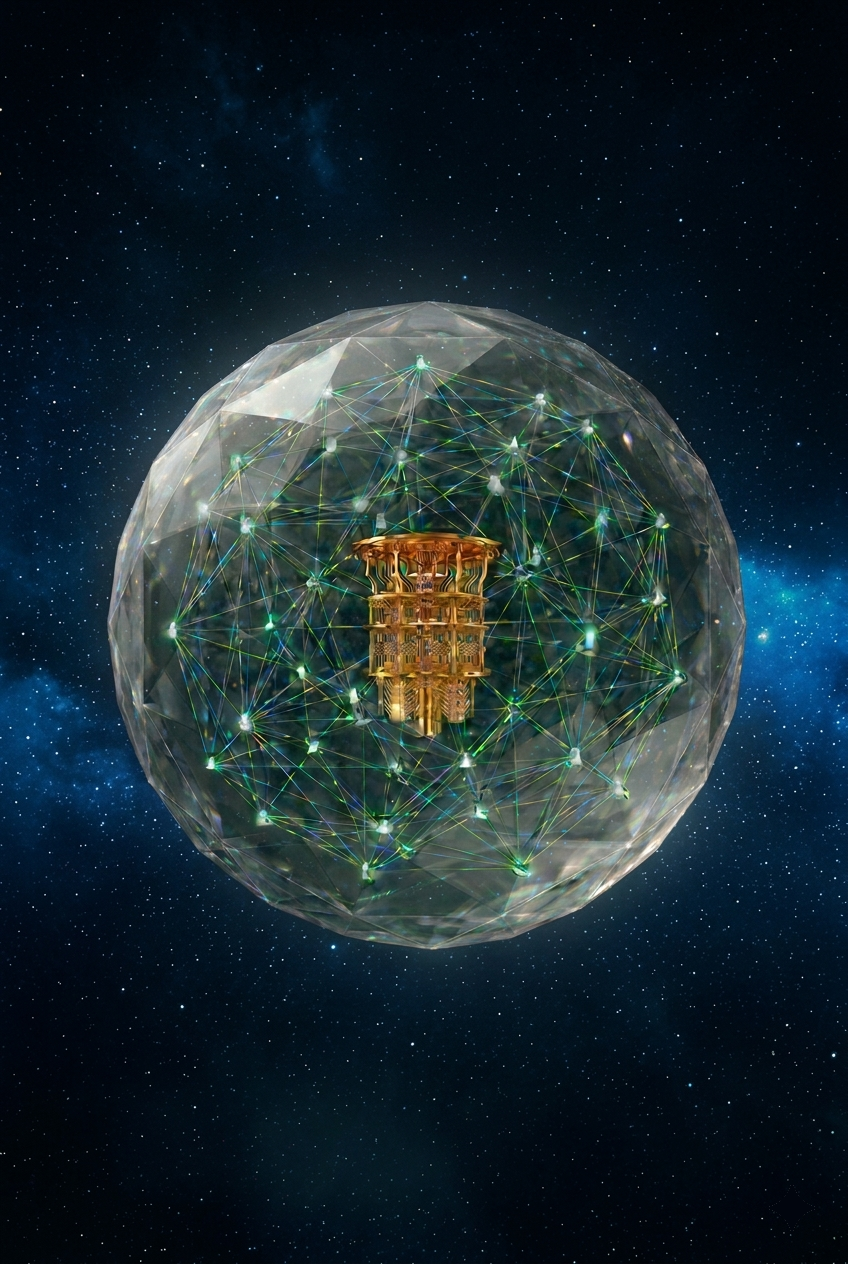
A quantum processor of sufficient power to cross-reference deep-space signal architecture with human genomic modeling — and act on what it finds.
A non-random signal from a star system 40 light-years away. Not a greeting. An instruction set — encoded for a biology it somehow already knew.
The most powerful quantum intelligence ever built doesn't operate from a laboratory. It operates from orbit — where space itself is the cooling system.
A novel that moves at the speed of a thriller and asks the questions of a philosophy. The waitlist is open — be first to know.